

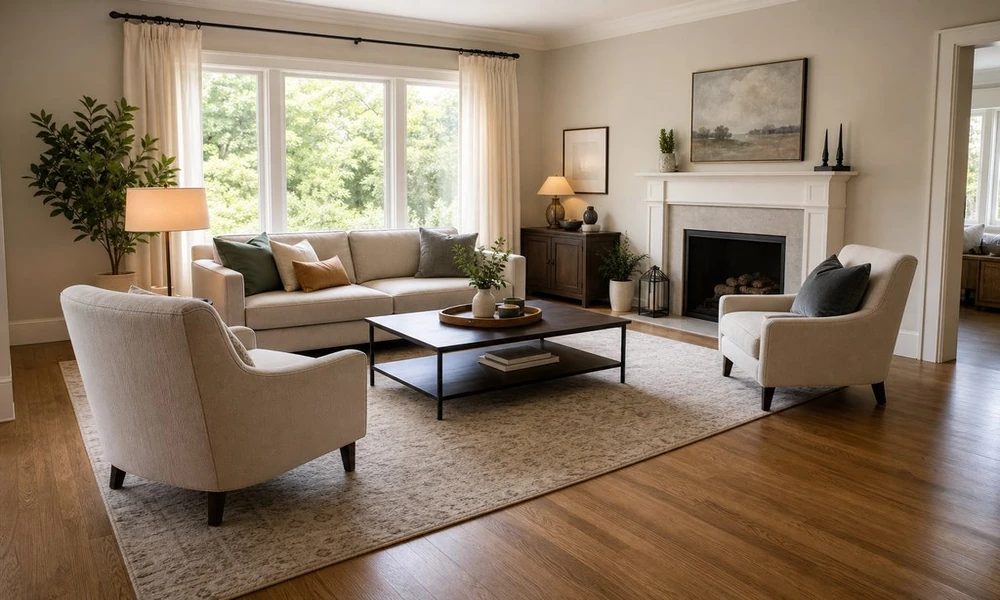
Living room seating and furniture layout
Start with what’s worth keeping. Inventory pieces worth keeping:
- Pieces used every day
- Items that provide needed storage
- Furniture with sentimental value
- Large items that restrict walking routes
- Pieces that can move to another room
Think about which pieces earn their place in the room on a regular basis, whether that’s a go-to chair, sturdy coffee table, a rug that’s still in great shape or even an heirloom piece like a cabinet. It can help to measure out these pieces before shopping, so you have a better sense of what you’ll be working with (consider the depth of pieces, as well as extra space you’ll need for opening doors or drawers, etc.).
This can also help you identify items that may no longer be serving their intended purpose (is there a table in there that’s only being used for dropping off the mail? A chair that isn’t seeing much use?).
Keeping some of your current furniture may not always be feasible or practical. But starting with your current furniture, rather than picking out a new sofa and then figuring out what else will and won’t work with it, can help you avoid coming home with a beautiful new sectional to realize none of your accent chairs, storage or tables will fit around it.
Everyday Priorities
When it comes to living room ideas and inspiration, it’s easy to get caught up in creating a beautiful space that also happens to check every aesthetic box. But the best living room designs tend to stem from what you need the space to be, whether that’s having a place for everyone to grab a seat with a drink, plenty of room to stretch out for a movie, a spot for your kiddo to do homework or just being able to get from one side of the room to the other without doing the furniture shuffle.
So, before shopping for living room furniture in Wyoming, MI, take stock of what is and isn’t working in the space, including any issues with crowding or function. nothing functional about it? underutilized?) and plan your living room furniture shopping list accordingly.
Seating Choices
Start with seating, but consider the needs of everyone who’s going to be using the space on a regular basis. Do you tend to entertain often? A sofa and chairs that face one another can offer a conversation-friendly environment. If movie marathons are more your thing, consider investing in deeper seating options (think: chaise lounges). And if your living room primarily doubles as a reading nook with the occasional drop-by guests, a sofa and a couple of movable chairs may hit the right balance.
Think, too, about ancillary needs. Will people need somewhere to prop up their feet? Where can they set down a drink, book or charge their device? And is there a regular footpath through the living room (especially for older family members who use a walker or need a straight shot from point A to B)?
Separate Seating or a Sectional?
Chairs and couches are easy to maneuver into different configurations (and can easily be angled toward one another conversation-style). And separate, but coordinated, seating can make sense if you’re working around lots of windows, doors or a fireplace, leaving limited wall space.
On the other hand, sectionals offer a cohesive lounge area and can help demarcate an open living room without the benefit of a wall behind it. If you’re comparing living room furniture options in the Wyoming, MI area, understanding your room’s layout beforehand can help you determine whether a sectional or separate seating pieces will work better for your space. Depending on the space, a sectional may also offer more seating in a smaller footprint than a combo of separate pieces. (Note: Not all sectionals are created equal, a right-facing chaise sectional won’t necessarily work in situations calling for a left-facing chaise.)
Measurements and Movement
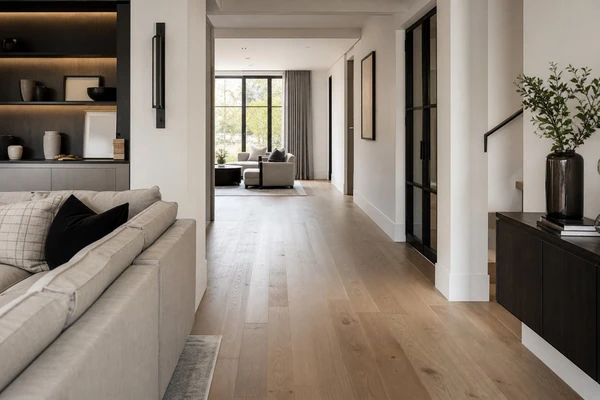
Sectional sofa dimensions and room layout
Protect Walking Routes
Rather than squeezing a walkway in between a couch and end table, it’s important to map out and protect existing traffic patterns, from entryways to seating, windows, storage or other adjoining rooms. Your living room layout doesn’t have to be symmetrical to be balanced; it simply has to leave room to maneuver.
- Enter the living room from the entryway (and exit, too!)
- Access windows, outlets, light switches, etc.
- Maneuver around the coffee table or ottoman
- Open and close cabinet doors, pull out drawers, etc. (media storage included!)
- Access the room to bring in groceries, haul away laundry, etc.
Final Checks
Beyond confirming your sectional’s final configuration and dimensions, it’s also a good idea to peruse its materials and care instructions before you place your order, too. Depending on its materials (upholstery, wood, leather, performance fabrics, etc.), you may want to take special care to clean and maintain your new sectional. Similarly, if you’re eyeing a bookcase, cabinet or other tall storage piece, follow any special instructions for anchoring the product, including the safety steps described at https://www.cnet.com/home/smart-home/how-to-anchor-furniture-to-the-wall, to ensure it’s stable in your home.
Put the Floor Plan to Work
Ultimately, a well-planned living room layout is one that balances aesthetics and practicality, leaving room to maneuver comfortably while ensuring each of its elements has a purpose. Before you place your order, take the time to create a floor plan (a quick sketch or tape-measured map will do!) of your ideal sectional configuration. From there, it’s simply a matter of double-checking its configuration and dimensions (and following any instructions for use and care)!
