

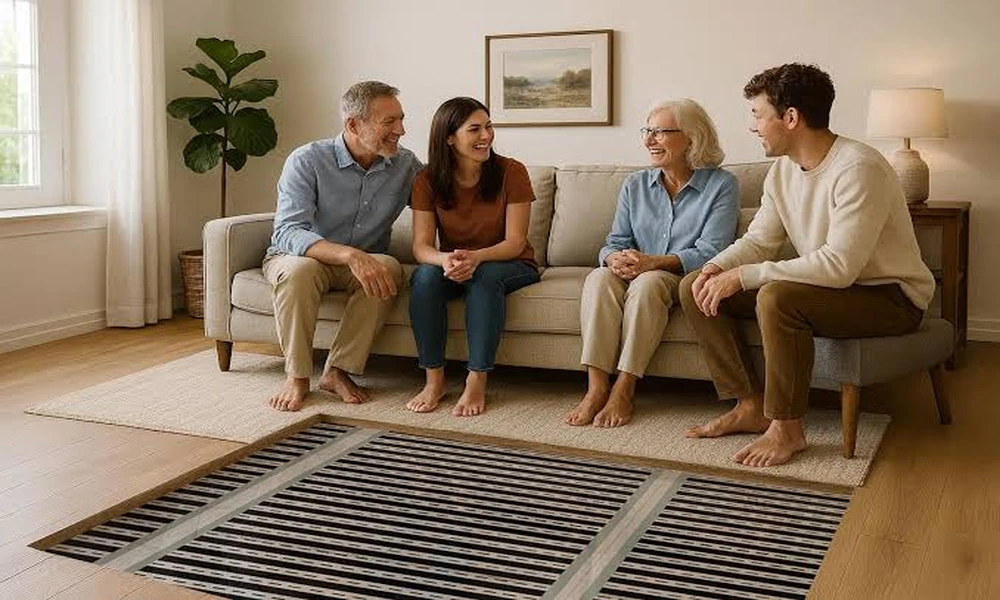
For most of the last century, home heating meant moving hot air around. Furnaces, ducts, and vents pushed warmth into rooms from above and blew it toward the ceiling, where heat naturally wants to go. It worked, more or less, but it always fought physics. Radiant floor heating flips that logic, warming the surface people actually touch and letting warmth rise gently from below. Once a luxury reserved for high-end builds, it is steadily becoming a mainstream expectation. That trajectory is worth understanding, because it hints at where residential comfort is heading next.
Why radiant heat is winning converts
The appeal starts with a simple physical truth. Heat rises, so a warm floor delivers comfort exactly where the body registers it, at foot level, then distributes gently upward. There are no cold spots near the floor, no drafts from forced air, and no dust blown around by a fan. Anyone who has stepped onto a heated bathroom tile on a January morning understands the draw immediately.
Beyond comfort, radiant systems run quietly and can be more efficient in the right applications, since they heat objects and surfaces rather than constantly reheating moving air. As energy costs climb and homeowners scrutinize efficiency, these advantages move from luxury to selling point. The technology that once signaled extravagance increasingly signals good sense.
What made it accessible
The critical development was not the heating element itself, which has existed for decades, but the systems that make installation practical for ordinary renovations. Modern uncoupling membranes changed the game. A product category like the underfloor heating membrane serves two roles at once, holding the heating cable in place and protecting the tile above from the substrate’s movement.
That dual function matters enormously. Before these membranes, embedding heating cable meant fussy clips and separate crack-isolation layers. Now a single membrane simplifies the process to something a determined DIY renovator can tackle, with only the final electrical connection reserved for a licensed professional. Lowering the installation barrier is what turned a niche feature into a realistic option for a routine bathroom remodel.
Electric versus hydronic, and why it matters for the forecast
Two broad technologies compete under the radiant banner. Electric systems use resistance cable and suit smaller areas like bathrooms and kitchens, where they are affordable to install and easy to control room by room. Hydronic systems circulate warm water through tubing and make sense for whole-house heating, especially in new construction, where their efficiency at scale shines.
The near future likely belongs to both, in their respective niches. Electric radiant will keep spreading through renovations, one warm bathroom or kitchen at a time, because it retrofits so cleanly. Hydronic will grow in new builds as heat-pump technology makes low-temperature water heating more efficient. The pairing of hydronic floors with heat pumps, in particular, points toward a genuinely efficient future for whole-home comfort.
The smart-control dimension
Where the technology gets most interesting is control. Modern radiant systems increasingly connect to smart thermostats that learn schedules, respond to occupancy, and warm a bathroom floor just before the alarm goes off. This addresses radiant heating’s one real drawback, its slower response time, by anticipating need rather than reacting to it.
As homes grow more connected, expect radiant zones to integrate with broader home automation, coordinating with ventilation, blinds, and energy management. The floor that warms itself before you wake, then eases off when the house empties, is not a distant fantasy. The pieces already exist and are converging.
What this means for renovators today
For anyone renovating now, the trend carries a practical lesson. Adding radiant heat during a floor replacement is far cheaper than retrofitting it later, because the disruptive part, lifting the existing floor, is already happening. The incremental cost of laying a membrane and cable while the subfloor is exposed is modest compared to tearing up a finished floor down the road.
This is why heated floors have quietly become a standard consideration in bathroom and kitchen remodels rather than an afterthought. The smart move is to at least price it while the floor is open. Even running the wiring and membrane for future use, without immediately activating it, preserves the option at a fraction of the later cost.
The flooring that goes on top
A detail often overlooked in the enthusiasm for heated floors is that not every floor covering suits radiant heat equally. The choice of finish material shapes both the comfort and the efficiency of the whole system, and getting it wrong wastes the investment.
Ceramic and porcelain tile are the ideal partners. They conduct heat well, store it, and release it steadily, which is why heated bathroom and kitchen floors are so often tiled. Natural stone behaves similarly. These dense materials make the most of the warmth the system generates.
Other floors demand more caution. Some engineered wood and laminate products are rated for use over radiant heat, but many are not, and exceeding their temperature limits can damage them or void the warranty. Solid hardwood is generally the riskiest, since it expands and contracts with heat and moisture. Vinyl and luxury vinyl vary by product, so the manufacturer’s specification is the only reliable guide.
The practical rule is to confirm compatibility before buying either the heating system or the floor above it. Pairing a heated system with an unsuitable covering either underperforms or shortens the floor’s life. Matching a conductive, heat-tolerant finish to the system, on the other hand, delivers the even, efficient warmth that makes radiant heating worth choosing in the first place. It also protects the considerable effort that goes into installing the heating layer, since tearing up a finished floor to correct a compatibility mistake is exactly the kind of costly redo a little planning prevents. The finish and the heat source are one decision, not two.
Looking ahead
The broad direction is clear. Radiant floor heating is moving from luxury to mainstream, propelled by better installation systems, rising interest in efficiency and comfort, and integration with smart home technology. It will not replace forced air everywhere overnight, and in many homes the two will coexist, radiant handling the rooms where comfort matters most.
But the momentum is real and, I would argue, deserved. Heating the surface people touch, quietly and efficiently, simply makes more sense than blowing hot air toward the ceiling. As the technology grows cheaper to install and smarter to control, the warm floor is likely to shift from a feature people are pleasantly surprised to find into one they expect. For homeowners planning a renovation, that shift is worth getting ahead of rather than catching up to later.
