

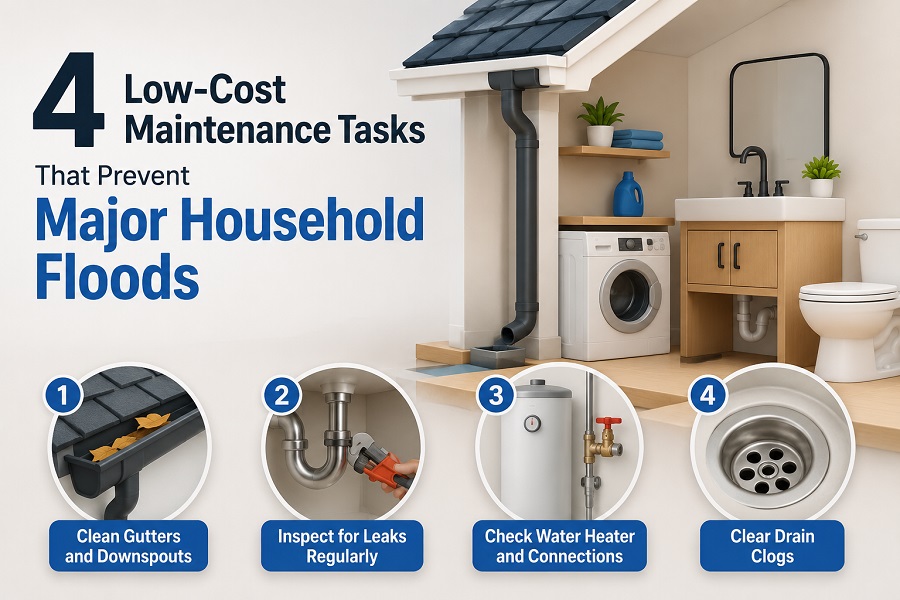
Water damage is often not immediately obvious, as it accumulates slowly in unseen places like behind walls, under the floors, or in hidden corners. Eventually, the damage becomes severe enough to be noticed, and at that point, the repair costs will likely make up for all the time and effort you didn’t invest in preventing it.
Replace rubber hoses before they fail
The washing machine hose that’s currently positioned behind your unit is most likely made of rubber. Over time, rubber degrades, cracks, and eventually, when it breaks while on full line pressure, it can release hundreds of gallons of water into your home in less than an hour. This is one of the most common, and easily avoidable causes of major indoor flooding, and the solution costs less than $30.
Braided stainless steel hoses are what you should replace them with. Easily found at any hardware store, screwing on in the exact same way as the originals, this will eliminate that failure point. Do the same to dishwasher supply lines if they haven’t been changed over recently. Take thirty minutes on a weekend afternoon, and swap them before they give out on you.
Clear gutters and redirect your downspouts
Clogged gutters filled with leaves and debris lose their purpose. When they’re full and the water starts flowing over the side, it doesn’t just create a little waterfall in your yard. It also directs the water to the side of your foundation so that it can pool there. Then all the water pressure lifts the liquid and sends it right through that concrete block and into your crawlspace or basement.
Most homes just need their gutters cleaned at least twice a year to prevent clogs. A deep spring and fall clean-out should do the trick. However, your downspouts can also cause a flooding problem. If your downspouts pour water right down at the foot of your foundation, you might as well be inviting a flood over for tea. Downspout extensions – plastic or concrete attachments that only cost a few bucks – guide that water 5 or 6 feet away from your home. Those few feet just might save your basement.
If extremely heavy rains keep you awake at night, a French drain can get even more water away from your foundation fast. But for most homes, just adding a few downspout extensions to those clean gutters should do the trick.
Test your sump pump before the season demands it
A sump pump that fails during heavy rain is worse than no sump pump at all – because it creates a false sense of security right up until the basement floods. The float switch is the most common failure point. It triggers the pump when water reaches a certain level, and if it’s stuck or corroded, the pump won’t activate.
Testing it takes five minutes. Pour a bucket of water into the pit and watch whether the float rises and the pump kicks on. If it doesn’t respond, you’ve found a problem on your terms rather than during a storm. While you’re at it, check the backup battery if your unit has one. A dead backup is the reason basements flood during power outages – exactly when the pump is needed most.
This is a once-a-year check that costs nothing but your time.
Watch your water pressure
Many homeowners couldn’t tell you the pressure their house runs at. Municipal water pressure can fluctuate, and if yours regularly exceeds 80 PSI, it’s silently grinding down pipe joints, supply valves, and appliance connections throughout the house. This wear doesn’t manifest in an “Oh, shoot!”, all-at-once rupture, but as a slow leak behind a wall that’s already led to five figures’ worth of structural damage by the time you discover it.
A water pressure gauge threads onto any hose bib and is less than $15. If you notice the pressure creeping north of 80 PSI, a water pressure regulator – either adjusted or totally new – will bring it back down to safe levels. This is the sort of under-the-hood maintenance that prevents the under-the-wall leak no one could predict.
Place smart water alarms under high-risk fixtures
Water heaters, refrigerators with ice makers, bathroom vanities, and washing machines are the usual suspects when slow leaks turn into floor damage. A battery-operated water leak detector sits under any of these appliances, costs around $10 to $20, and sounds an alarm the moment it detects moisture.
That early warning is everything. A leak caught the same day is a towel-and-a-call situation. A leak that goes unnoticed for a week is a mold problem, a structural problem, and a very different kind of phone call. Water damage and freezing are the second most common cause of home insurance claims, affecting roughly 1 in 50 insured homes with an average payout of around $12,500 (Insurance Information Institute). A $15 sensor is a reasonable investment against those odds.
If preventative steps fail or a severe storm overwhelms a home’s drainage, the window to act is narrow – professionals who handle Water Damage Restoration Seattle Wa can extract standing water and dry out the structure before mold remediation becomes a secondary problem on top of everything else.
Keep the checklist short
Here are four easy DIY checks you can do over a weekend for under $50: Replace old hoses, clear the gutters and extend downspouts, test the sump pump, and check water pressure. Throw in a few smart sensors in the high-risk spots and you’ve got yourself a pretty low-cost early warning system for your home. That’s not an engineering project. That’s just maintenance – done before it turns into a disaster.
